Home About Services Blog TOC References Contact
Feb
22

Competitive Intelligence Signal-to-Noise

Tom Hawes Competitive Intelligence, Early Warning, Strategy Effectiveness Add your comment

Early in my career, I supported the computers that ran a machine shop factory. The factory was a large, open room filled with machinery of every sort designed to form, cut and polish metal fixtures. I remember things about that factory. One memory is of the smell of machine oil. Another memory was of the cleanliness of the aisles between the production machines. The primary memory, however, was of the sound. When the factory was running (most of the time), there were all kinds of sounds. Drills, cutters, polishers and packaging machines were operating at the same time. Though it was possible to carry on a conversation in the factory, it was not the best place to hear or communicate important messages. Of course, overhearing conversations was just about impossible.

There were ways to get around all of this noise.

  • You could take advantage of the times that the factory shut down. That removed all of the background noise. Unfortunately (if your goal was talking instead of production), this happened very infrequently.
  • If you knew exactly who to talk to, you could move close to them and speak loudly. If you were the listener, the right strategy was to focus on the speaker’s words while ignoring the barrage of other sounds.
  • If you wanted to “overhear” something, then the only recourse was to become involved in the conversation. That, of course, depended on the acquiescence of the other participants. Thus, you were unlikely to hear much of value accidently.

Conversely, some approaches would only make the problem worse.

  • You would not want a goal of hearing everything that was being said in the factory. That would simply complicate the problem of separating an important conversation from the background machine noise. Lack of focus was a sure way to hear nothing of value.
  • You would never want to amplify the sounds in the factory. Though this might increase the volume of the speaker’s voice, it would also increase the sounds from the machinery.
  • You would not want to encourage people to whisper. Obviously, this made it harder to hear since the level of noise would overwhelm the conversation

Both of these lists could go on and on. They illustrate the common problem that we have of separating the important from the unimportant. The difficulty arises because every important communication is surrounded by background (i.e., contextually unimportant) noise. The world (much like the factory) is full of noise. What we want to hear is typically competing with so much that is unimportant (or less important). Furthermore, sometimes we want to “overhear” or discern things not originally meant for us. The background noise makes that task especially hard.

Thus, we get to the fundamental task in competitive intelligence. That is, targeting the signals that we desire to hear, decreasing the “volume” of the background noise and, finally, interpreting the important signals correctly.

Read the rest of this entry

VN:F [1.9.3_1094]
please wait...
Rating: 0.0/5 (0 votes cast)
VN:F [1.9.3_1094]
Rating: +1 (from 1 vote)
Print
Competitive Intelligence, Early Warning, Strategy Effectiveness
Jan
26

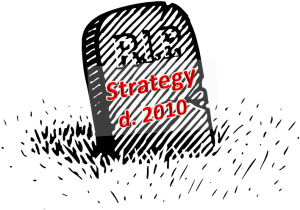
Strategy is Dead (5 Translations)

Tom Hawes Strategy Effectiveness 1 comment

An article in yesterday’s Wall Street Journal announced, “strategic plans lose favor” in the current economic environment. Executives, it reported, were adopting “just-in-time” decision-making according to a partner at McKinsey & Co. There is no longer time to “predict the future” and, anyway, the future was too uncertain. Now, quick adaptation and decisions were needed. Amazingly, some companies had even created “situation rooms” to monitor current events to support quicker decisions. An Accenture manager summarized by saying, “strategy, as we knew it, is dead.”

Wow. Who would have thought that we would see the death of strategy in our lifetimes?

After all, strategy has been employed in so many ventures over hundreds (thousands?) of years and now, apparently due to the recent economic issues, it is “dead.” This shocks me as much as seeing the Berlin Wall fall in 1989 or as seeing Sadat address the Israeli Knesset in 1977. Are we experiencing a radical transition to a post-strategy business era where reflexive actions completely replace strategic reflection?

I doubt it. It would be better for readers of such pronouncements to translate the death knell statements to what they really mean.

Read the rest of this entry

VN:F [1.9.3_1094]
please wait...
Rating: 4.0/5 (2 votes cast)
VN:F [1.9.3_1094]
Rating: +1 (from 1 vote)
Print
business strategy, Strategy Effectiveness
Jan
26

Competitive Intelligence Challenges

Tom Hawes Competitive Intelligence, Strategy Effectiveness 2 comments

Competition is a constant.

My son competes in basketball. His team has many challenges. Perhaps the biggest challenge is that they are a new team (formed this year) competing against established teams that have played together for multiple seasons. Moreover, the other teams have “serious” coaches that teach sophisticated offenses and defenses. Those teams execute plays with coordination, skill and timing that give them decided advantages against less prepared teams.

Here is an interesting point. My son’s team has talented athletes. In fact, they have enough talent to win any game (even against the best teams in the league). Talent alone, however, is not enough. They need to have better offensive and defensive plays. They need to make better adjustments during the game to react to what the other team is doing. They need to learn more from their opponents to make their team better.

Is business any different?

Read the rest of this entry

VN:F [1.9.3_1094]
please wait...
Rating: 0.0/5 (0 votes cast)
VN:F [1.9.3_1094]
Rating: +1 (from 1 vote)
Print
change, Competitive Intelligence, Strategy Effectiveness
Jan
21

Strategy Help: Someone to Talk With

Tom Hawes Strategy Effectiveness 4 comments

The survey was unscientific. Nevertheless, the results were a bit surprising (and valuable) to me. Perhaps they might reflect your situation as well. Maybe you are facing similar challenges in 2010 to improve your strategy effectiveness. You can download the survey here and view the complete set of results here.

The respondents answered five basic questions about strategy facing their organization or work group in the year ahead. The fourteen organizations mostly represented high technology companies ranging in annual revenues from $30M to greater than $10B. However, there were also startups and nonprofits included.

Here were the questions that I asked.

  1. What is your relationship to strategy decision makers in your company or work group?
  2. What types of strategy do you influence or decide in your company or work group?
  3. How would you assess your company’s or work group’s strategy effectiveness?
  4. What critical strategy challenges does your company or work group face in 2010?
  5. What types of strategy help would help you most?

From the (admittedly) small sample, several interesting responses jump out.

Read the rest of this entry

VN:F [1.9.3_1094]
please wait...
Rating: 0.0/5 (0 votes cast)
VN:F [1.9.3_1094]
Rating: 0 (from 0 votes)
Print
management, Strategy Effectiveness, strategy evaluation
« Previous Entries
Next Entries »
  • Archives

    • July 2010 (3)
    • June 2010 (1)
    • May 2010 (5)
    • April 2010 (5)
    • March 2010 (4)
    • February 2010 (4)
    • January 2010 (6)
    • December 2009 (2)
    • November 2009 (2)
    • October 2009 (7)
    • September 2009 (6)
    • August 2009 (11)
    • July 2009 (9)
    • June 2009 (12)
    • May 2009 (6)
    • April 2009 (4)
    • March 2009 (12)
    • February 2009 (5)
  • Categories

    • Competitive Intelligence (89)
    • Early Warning (6)
    • Maintenance (1)
    • Organizational Development (13)
    • Strategy Effectiveness (52)
  • Recent Posts

    • Competitive Intelligence Practices for SMBs
    • Competitive Intelligence Priorities for SMBs
    • Competitive Intelligence Value for SMBs
    • Competitive Intelligence: The Balance of Humility and Expertise
    • Competitive Intelligence is a Word Problem
  • Tag Cloud

    Academy of Competitive Intelligence alignment analysis analytical techniques Apple approximations behavioral modeling Branding business development business strategy case studies change CI techniques Competitive Intelligence consulting decision making Early Warning Ed Tufte effective presentations evaluation facilitation failure signs future focus gap analysis graphical facilitation ideas infrastructure Innography integrity job listings management Marketing Michael Porter product marketing professional competence SCIP senior management SMB strategy Strategy Effectiveness strategy evaluation strategy implementation survey SWOT trap question
Strategically Thinking · coogee theme · 2008
RSS Feed · WordPress · TOP